Introduction
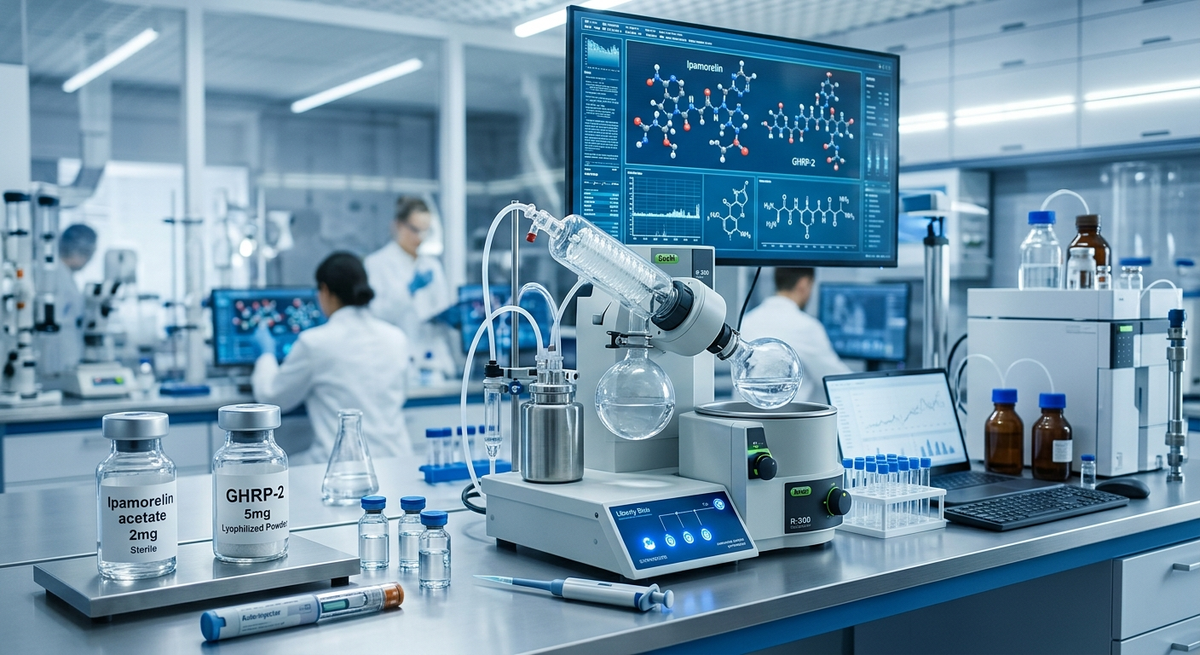
Ipamorelin and GHRP-2 are both growth hormone secretagogues that act on the ghrelin receptor (GHS-R1a), but they differ in potency, selectivity, and side effect profiles. GHRP-2 is generally considered the most potent synthetic GHRP for raw GH release, while ipamorelin offers the cleanest selectivity with minimal hormonal cross-talk. Researchers selecting between them must balance peak GH amplitude against the importance of avoiding cortisol and prolactin confounding.
Mechanism of Action Comparison
Both peptides bind GHS-R1a receptors to trigger intracellular calcium release and cAMP signaling in pituitary somatotrophs, resulting in GH secretion. Ipamorelin demonstrates remarkable selectivity, releasing GH without proportional increases in other pituitary hormones even at supraphysiological doses. GHRP-2, while highly potent for GH release, also stimulates ACTH and cortisol (though less than GHRP-6), produces moderate prolactin elevation, and has mild appetite-stimulating properties.
Notably, GHRP-2 has been shown to produce higher peak GH levels than ipamorelin at equivalent doses, making it attractive when maximum GH amplitude is the primary endpoint. However, this comes at the cost of reduced hormonal selectivity.
Key Differences
| Feature | Ipamorelin | GHRP-2 |
|---|---|---|
| GH Release Potency | Moderate-high | Highest among GHRPs |
| Selectivity | Excellent (cleanest GHRP) | Good (better than GHRP-6) |
| Cortisol Elevation | None | Mild (~10% increase) |
| Prolactin Elevation | None | Mild-moderate |
| Appetite Stimulation | Minimal | Mild |
| Dose-Response Ceiling | Present (self-limiting) | Higher ceiling |
Research Applications
Ipamorelin remains the gold standard for combination protocols with CJC-1295 No DAC or Sermorelin where hormonal purity is essential. GHRP-2 is preferred in studies focused on maximizing acute GH peaks, in GH-deficiency models, or when its moderate cortisol/prolactin co-stimulation is either acceptable or itself an endpoint. Both peptides are used in body composition, sleep quality, and anti-aging research.
Which to Choose for Your Research?
Choose ipamorelin for protocols requiring clean GH isolation, combination studies with GHRH analogs, and long-term research where minimizing HPA axis stimulation matters. Choose GHRP-2 when maximum GH release amplitude is the primary goal or when its broader hormonal profile is relevant to your research question. For most general GH-axis work, ipamorelin's selectivity makes it the safer default.