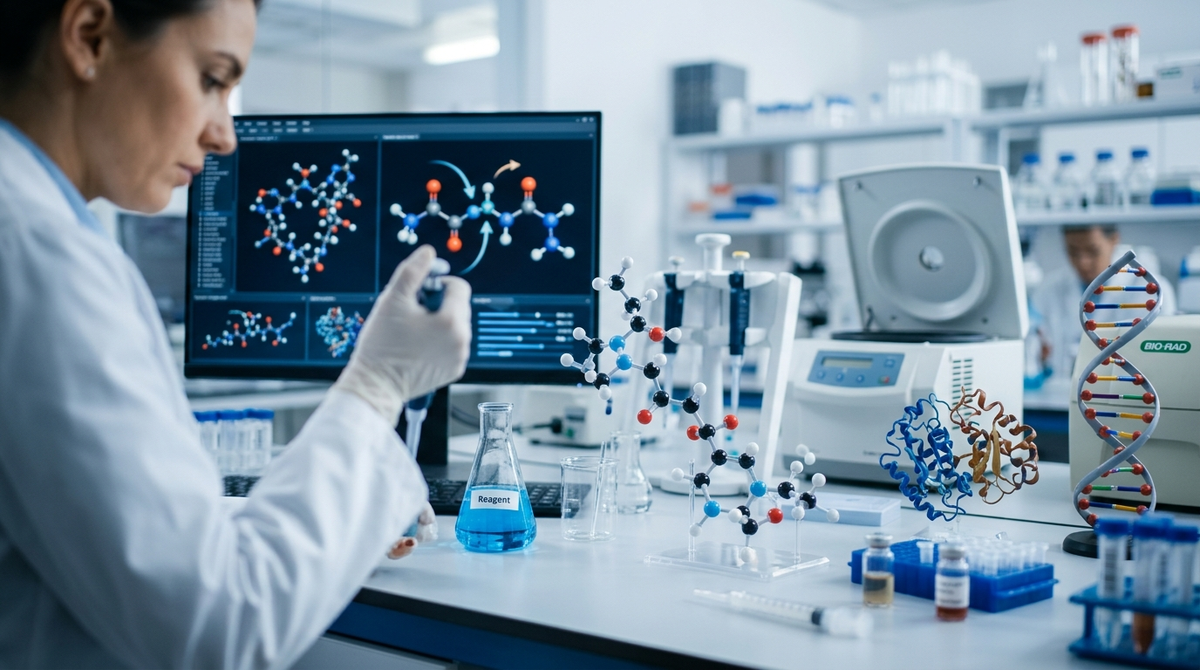
What Is a Peptide Bond?
A peptide bond is a covalent chemical bond formed between two amino acids when the carboxyl group (-COOH) of one amino acid reacts with the amino group (-NH₂) of another, releasing a molecule of water in a condensation (dehydration synthesis) reaction. The resulting amide bond (-CO-NH-) is the fundamental linkage that holds peptides and proteins together.
Despite being thermodynamically unfavorable under standard conditions (ΔG° ≈ +2-4 kcal/mol), peptide bond formation occurs readily in biological systems thanks to the catalytic power of the ribosome, which lowers the activation energy and couples the reaction to GTP hydrolysis during translation.
The Chemistry of Peptide Bond Formation
The mechanism of peptide bond formation follows a nucleophilic acyl substitution pattern. The α-amino group of the incoming amino acid acts as a nucleophile, attacking the electrophilic carbonyl carbon of the activated carboxyl group on the growing peptide chain. This proceeds through a tetrahedral intermediate before the leaving group departs and water is released.
Key Steps in the Mechanism
- Activation: In biological systems, amino acids are first activated by aminoacyl-tRNA synthetases, which attach each amino acid to its corresponding tRNA molecule using ATP hydrolysis. This activation step stores the energy needed to drive the subsequent condensation reaction.
- Nucleophilic attack: The free α-amino group on the aminoacyl-tRNA in the ribosomal A-site attacks the ester bond linking the growing peptide chain to the tRNA in the P-site.
- Tetrahedral intermediate: A brief tetrahedral intermediate forms at the carbonyl carbon before collapsing to yield the new peptide bond.
- Water release: The net reaction releases one water molecule per peptide bond formed, making this a dehydration synthesis reaction.
Ribosomal Catalysis
The ribosome's peptidyl transferase center (PTC), located in the large ribosomal subunit, catalyzes peptide bond formation. Remarkably, the PTC is composed primarily of ribosomal RNA (rRNA) rather than protein, making the ribosome a ribozyme - an RNA-based enzyme. Structural studies by Ada Yonath, Venkatraman Ramakrishnan, and Thomas Steitz (Nobel Prize in Chemistry, 2009) revealed the atomic details of this catalytic center[1].
The ribosome accelerates peptide bond formation by approximately 107-fold compared to the uncatalyzed reaction. It achieves this through precise positioning of substrates (entropy reduction) rather than traditional acid-base catalysis, though the exact mechanism continues to be refined through structural and computational studies.
Thermodynamics and Kinetics
While peptide bond formation is endergonic under standard conditions, the coupling to aminoacyl-tRNA hydrolysis and the subsequent release of pyrophosphate (with its exergonic hydrolysis) drives the overall reaction forward. The equilibrium strongly favors synthesis when amino acids are activated as aminoacyl-tRNAs.
The peptide bond has partial double-bond character due to resonance between the C=O and C-N bonds, resulting in a planar, rigid structure with restricted rotation - a property that has profound implications for protein folding and stability.
Chemical Peptide Synthesis
In the laboratory, peptide bonds are formed using chemical coupling reagents because the direct condensation reaction is too slow and non-specific. Common approaches include:
- Carbodiimide coupling: Reagents like DCC (dicyclohexylcarbodiimide) or EDC activate the carboxyl group for nucleophilic attack
- Active ester methods: Pre-formed active esters (NHS esters, pentafluorophenyl esters) provide faster, cleaner coupling
- Phosphonium/uronium reagents: HBTU, HATU, and PyBOP are modern coupling reagents that offer rapid, high-yield peptide bond formation with minimal racemization
These chemical methods are the foundation of solid-phase peptide synthesis (SPPS), the dominant method for producing synthetic peptides for research and therapeutic applications.
For related insights, see our article on Covalent properties of peptide bonds.
Clinical and Research Significance
Understanding peptide bond chemistry is fundamental to pharmaceutical peptide development. The stability of the amide bond under physiological conditions (half-life of ~350-600 years for hydrolysis at neutral pH) makes peptides inherently stable molecules, though enzymatic proteolysis remains the primary degradation pathway in biological systems. This understanding drives the development of modified peptides with enhanced protease resistance, such as D-amino acid substitutions, N-methylation, and cyclization strategies[2].